
Description
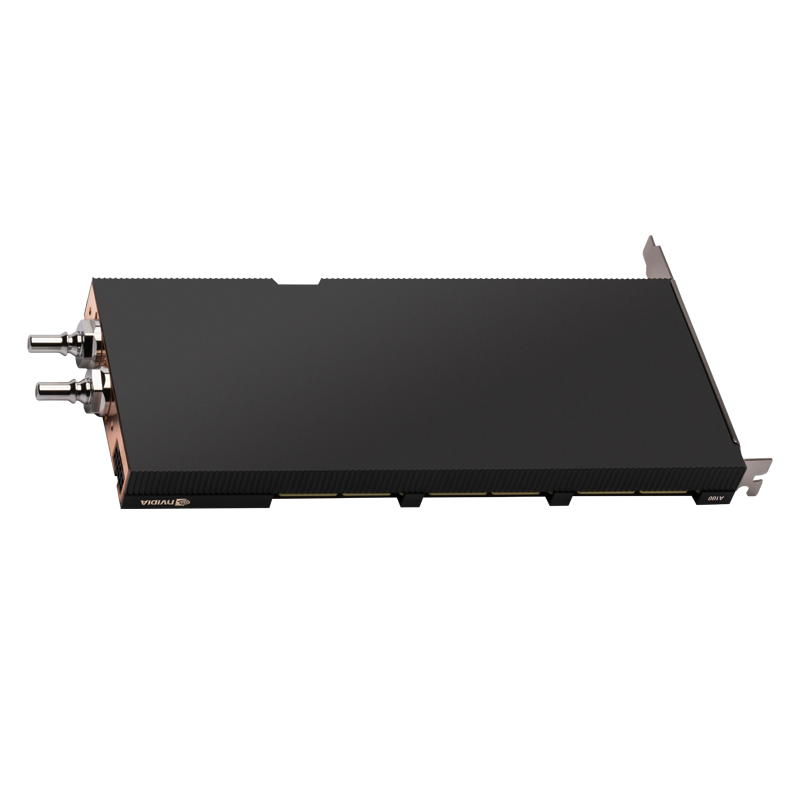
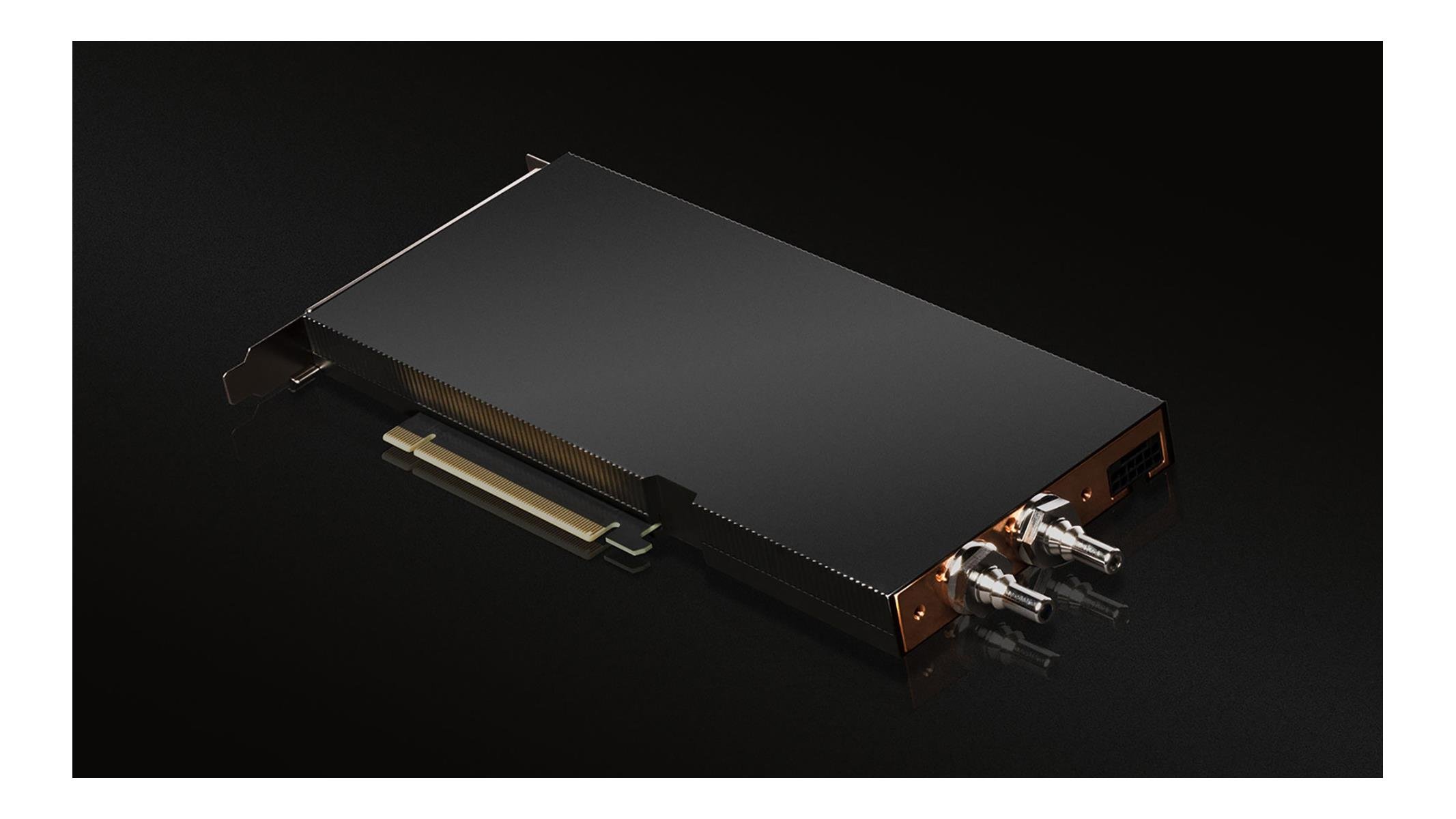
The NVIDIA A100 Liquid Cooled Tensor Core GPU represents a breakthrough in modern data center acceleration technology, redefining the standards for computational power, energy efficiency, and thermal management. Built on NVIDIA’s advanced Ampere architecture, this GPU is purpose-engineered to handle the most demanding workloads in artificial intelligence (AI), high-performance computing (HPC), and large-scale data analytics with remarkable efficiency and scalability.
Exceptional Computational Performance
At the heart of the A100 Liquid Cooled GPU lies a massive array of 6,912 CUDA cores and 432 third-generation Tensor Cores, enabling it to deliver staggering performance metrics. With 80 GB of ultra-fast HBM2e memory and a memory bandwidth reaching up to 2 terabytes per second (TB/s), the GPU can rapidly access and process colossal datasets, critical for training and inference in state-of-the-art AI models.
Its support for multiple precisions including FP64, FP32, TF32, BF16, FP16, and INT8 allows the A100 to flexibly optimize accuracy and speed depending on the computational requirements. This adaptability makes it suitable for a broad spectrum of applications, from scientific simulations requiring double precision to deep learning models benefitting from mixed precision acceleration.
Advanced Cooling Technology: Liquid Cooling
One of the defining features of this variant is its liquid cooling system, which fundamentally changes the way thermal management is handled in data centers:
- Efficient Heat Dissipation: By using liquid (usually water or a coolant mix) circulated directly through cold plates attached to the GPU, heat is removed much more effectively than traditional air cooling. This ensures the GPU operates at optimal temperatures even under maximum load, preventing thermal throttling that can degrade performance.
- Energy Savings: Liquid cooling reduces the power consumption associated with running fans and air conditioning units in data centers. Studies show up to 30% reduction in overall energy use, translating into lower operating costs and a smaller environmental footprint.
- Higher Density Deployment: Thanks to superior heat management, the liquid-cooled A100 is designed in a single-slot form factor, allowing more GPUs to be packed into the same rack space compared to larger, air-cooled dual-slot GPUs. This increases computational density and maximizes data center investment.
- Sustainability and Water Use: Unlike evaporative cooling systems, closed-loop liquid cooling conserves water and minimizes environmental impact, aligning with growing sustainability goals of modern enterprises.
Application Domains and Workload Optimization
The A100 Liquid Cooled GPU is engineered to accelerate a wide array of mission-critical workloads:
- Artificial Intelligence: From training massive neural networks for natural language processing and computer vision to real-time inference in autonomous vehicles, healthcare diagnostics, and recommendation systems.
- High-Performance Computing (HPC): Supports complex simulations and scientific research tasks including climate modeling, molecular dynamics, and physics simulations with high precision and speed.
- Data Analytics and Big Data: Enables rapid processing and querying of large datasets, empowering enterprises to derive insights faster, improve decision-making, and handle real-time data streams efficiently.
- Multi-Instance GPU (MIG) Capability: This GPU can be partitioned into up to seven independent GPU instances, allowing multiple users or workloads to run simultaneously without interference, improving resource utilization and operational flexibility.
Compatibility and System Integration
The NVIDIA A100 Liquid Cooled GPU is supported across a broad ecosystem of server platforms designed for liquid cooling infrastructure. Major OEMs such as Supermicro, Lenovo ThinkSystem, ASUS, and others provide ready-to-deploy solutions that incorporate optimized cooling hardware, power delivery, and system management tools. This ensures seamless integration in enterprise data centers and cloud environments, allowing organizations to upgrade their compute capabilities with minimal disruption.
The NVIDIA A100 Liquid Cooled Tensor Core GPU delivers an unparalleled combination of cutting-edge computational power, efficient thermal management, and operational sustainability. By leveraging liquid cooling, it sets new standards for performance density and energy efficiency, making it a cornerstone for modern AI, HPC, and data analytics infrastructures aiming to meet the exponential growth of compute demand while reducing costs and environmental impact.
Key Specifications
- GPU Architecture: NVIDIA Ampere GA100
- CUDA Cores: 6,912
- Tensor Cores: 432 (Third-generation)
- Memory: 80 GB HBM2e
- Memory Bandwidth: Up to 2 TB/s
- Interface: PCIe Gen 4.0 x16
- Form Factor: Single-slot
- Thermal Design Power (TDP): 300W
- Multi-Instance GPU (MIG): Supports up to 7 instances
- NVLink Support: 2-way NVLink bridge for up to 600 GB/s interconnect bandwidth
Advanced Features
The NVIDIA A100 Liquid Cooled GPU is packed with cutting-edge features designed to maximize performance, versatility, and efficiency across a wide range of demanding workloads. Below is a deeper dive into its advanced capabilities:
-
TensorFloat-32 (TF32) Acceleration
TF32 is a new precision format introduced by NVIDIA to accelerate AI training and inference. It provides the accuracy of FP32 (single precision floating-point) with the computational speed closer to FP16 (half precision). Specifically:
- TF32 allows the A100 GPU to deliver up to 156 teraflops (TFLOPS) of performance in AI training, which can be doubled to 312 TFLOPS when leveraging sparsity (a technique that exploits zero values in data to accelerate computations).
- This innovation means researchers and developers can train deep neural networks faster without compromising model accuracy.
- TF32 simplifies AI model development by eliminating the need for extensive mixed-precision tuning.
-
Mixed-Precision Support
The A100 supports a broad spectrum of numerical precisions:
- FP64 (Double Precision): Essential for scientific computations and HPC workloads requiring maximum numerical accuracy.
- FP32 (Single Precision): Standard for many compute and AI tasks.
- TF32 (TensorFloat-32): Optimized for deep learning acceleration.
- BF16 (Brain Float 16): Widely used in AI for balancing speed and precision.
- FP16 (Half Precision): Enables faster compute with reduced memory bandwidth.
- INT8 (8-bit Integer): Crucial for AI inference workloads, providing lower latency and higher throughput.
This flexible precision support enables the A100 to efficiently handle diverse applications, ranging from scientific simulations to real-time AI inference, by selecting the best precision for each task.
-
Multi-Instance GPU (MIG) Technology
MIG is a groundbreaking feature that allows a single A100 GPU to be partitioned into up to seven fully isolated GPU instances. Each instance operates independently with its own dedicated resources such as cores, memory, and cache. This offers several benefits:
- Improved Utilization: Enables multiple users or workloads to share a single physical GPU without interference, maximizing resource use.
- Workload Flexibility: Different workloads with varying compute demands can run simultaneously, improving overall throughput.
- Security and Isolation: Ensures workloads are securely isolated, a key requirement in multi-tenant cloud environments.
- Simplified Management: Each instance can be managed independently, simplifying scheduling and orchestration in data centers.
-
Structured Sparsity
Structured sparsity is a technique that leverages the fact that many AI models have large amounts of zero or near-zero values in their weight matrices. By skipping these zeros during computation:
- The A100 GPU can effectively double AI inference throughput without sacrificing model accuracy.
- This leads to faster inference times and more efficient use of GPU resources, especially valuable in production AI applications like speech recognition, recommendation systems, and natural language processing.
-
High Memory Bandwidth
With 80 GB of HBM2e (High Bandwidth Memory 2nd generation enhanced) and a memory bandwidth up to 2 TB/s, the A100 Liquid Cooled GPU provides extremely fast access to data:
- This is crucial for workloads involving very large datasets or models, such as natural language processing with billions of parameters.
- High memory bandwidth ensures that the GPU cores are fed with data at the required pace, avoiding bottlenecks and ensuring smooth, consistent performance.
Together, these advanced features make the NVIDIA A100 Liquid Cooled GPU a versatile powerhouse optimized for:
- AI model training and inference acceleration with TF32 and sparsity.
- Flexible, precision-adaptive computation across multiple domains.
- Efficient, multi-tenant GPU resource utilization through MIG.
- Handling large-scale data workloads with unmatched memory bandwidth.
This makes the A100 Liquid Cooled GPU an essential component for modern data centers aiming to meet the rapidly evolving demands of AI, HPC, and data analytics.
Liquid Cooling Advantages
Liquid cooling technology represents a transformative approach to managing the intense heat generated by high-performance GPUs like the NVIDIA A100. Unlike traditional air cooling, which relies on fans and airflow to dissipate heat, liquid cooling uses a liquid medium—usually water or a special coolant—that circulates directly over the GPU’s hottest components. This method provides several critical advantages:
-
Superior Thermal Management
- Direct-to-Chip Cooling: Liquid cooling uses cold plates that are in direct contact with the GPU die and memory chips. This direct heat transfer is far more efficient than air cooling, which must move heat through multiple layers before it escapes the system.
- Consistent Operating Temperatures: By rapidly removing heat, liquid cooling keeps the GPU operating at stable and lower temperatures even under sustained heavy workloads. This prevents thermal throttling—where the GPU reduces its clock speed to avoid overheating—thus maintaining maximum performance.
- Increased Hardware Longevity: Lower operating temperatures reduce thermal stress on components, potentially extending the lifespan of the GPU and associated hardware.
-
Energy Efficiency and Cost Savings
-
- Reduced Power Consumption: Fans and air conditioning units in data centers consume substantial energy. Liquid cooling decreases the need for these devices, resulting in approximately 30% energy savings in cooling costs.
- Lower Total Cost of Ownership (TCO): Although liquid cooling systems require upfront investment, the energy savings and improved hardware longevity contribute to a lower overall cost of operation and maintenance over time.
-
Higher Compute Density
-
- Single-Slot Form Factor: Traditional high-performance GPUs are often dual-slot due to the space required for large heatsinks and fans. Liquid cooling allows the A100 GPU to be designed in a compact single-slot form factor.
- More GPUs per Rack: The smaller size and improved heat dissipation mean more GPUs can fit into the same rack space, effectively doubling the compute power per rack unit.
- Better Data Center Space Utilization: This higher density is vital for maximizing the efficiency and scalability of data centers, especially those running large-scale AI and HPC workloads.
-
Sustainability and Environmental Benefits
-
- Water Conservation: Unlike evaporative cooling systems that use large amounts of water for heat rejection, closed-loop liquid cooling systems recirculate coolant with minimal water loss, making them more environmentally friendly.
- Reduced Carbon Footprint: Lower power consumption and more efficient cooling contribute to reducing the carbon footprint of data centers.
- Compliance with Green Data Center Standards: Many organizations are under increasing pressure to adopt sustainable IT practices; liquid cooling technology helps meet these goals by minimizing environmental impact.
-
Improved Noise Levels
-
- Quieter Operation: Liquid cooling systems reduce the reliance on high-speed fans, leading to significantly quieter data center environments. This can improve working conditions for data center staff and reduce noise pollution.
In summary, the liquid cooling solution in the NVIDIA A100 Liquid Cooled GPU is not just a technical upgrade but a strategic innovation that offers:
- Optimized GPU performance through superior thermal regulation.
- Substantial energy savings and operational cost reductions.
- Enhanced compute density for maximizing data center investments.
- Sustainable cooling with environmental and regulatory benefits.
- Quieter and more manageable data center environments.
Together, these advantages make liquid cooling a vital enabler for next-generation AI, HPC, and data analytics infrastructure, ensuring high performance without compromising efficiency or sustainability.
Compatibility and Integration
The NVIDIA A100 Liquid Cooled GPU is designed to deliver maximum performance within modern data center environments. However, achieving the full benefits of this advanced GPU requires careful consideration of system compatibility and integration with existing or new infrastructure. Below is an in-depth overview of the key compatibility and integration aspects:
-
Compatibility with Server Platforms
- Supported OEM Partners: The A100 Liquid Cooled GPU is fully supported and validated on a wide range of server platforms by major OEMs such as Supermicro, Lenovo ThinkSystem, ASUS, Dell EMC, HPE, and Inspur. These vendors offer pre-configured or customizable servers designed specifically for liquid cooling solutions, ensuring seamless hardware and firmware compatibility.
- PCIe Interface: The GPU connects via PCIe Gen4 x16 interface, which offers high-speed data transfer between the GPU and the host CPU. To leverage its full bandwidth potential, the server motherboard and CPU must support PCIe 4.0 or higher.
- Form Factor and Physical Dimensions: Thanks to liquid cooling, the A100 comes in a single-slot form factor, unlike traditional dual-slot GPUs. This compact design requires compatible server chassis with appropriate liquid cooling cold plate mounts and coolant inlet/outlet connections.
-
Liquid Cooling Infrastructure Integration
- Closed-Loop Cooling Systems: The A100 Liquid Cooled GPU integrates with closed-loop liquid cooling infrastructure typically used in high-density data centers. This includes pumps, cold plates, tubing, coolant reservoirs, and heat exchangers that circulate coolant to remove heat from the GPU effectively.
- Compatibility with Existing Cooling Plants: Many data centers already use chilled water or other liquid cooling plants. The A100’s cooling system is designed to be compatible with these setups, facilitating integration without the need for a complete overhaul of cooling infrastructure.
- Cooling Management and Monitoring: OEM server systems supporting the A100 typically provide comprehensive cooling management tools, including temperature sensors, flow rate monitors, and fail-safe mechanisms. These tools integrate with data center infrastructure management (DCIM) systems to ensure reliable operation and rapid response to any thermal anomalies.
-
System Software and Driver Support
- NVIDIA GPU Drivers and CUDA Toolkit: The A100 Liquid Cooled GPU is fully supported by NVIDIA’s enterprise-grade drivers and software stack, including the CUDA Toolkit, cuDNN, and TensorRT. These software tools are critical for enabling optimized AI and HPC applications to fully utilize the GPU’s hardware capabilities.
- NVIDIA AI and HPC Software Ecosystem: The GPU is compatible with NVIDIA’s full suite of AI frameworks and libraries (such as TensorFlow, PyTorch, and RAPIDS), enabling straightforward deployment of AI models and HPC workloads.
- Operating System Support: The GPU drivers support major enterprise operating systems including various Linux distributions (Ubuntu, CentOS, RHEL) and Windows Server editions, ensuring broad compatibility in enterprise environments.
-
Power and Electrical Compatibility
- Power Delivery: The A100 Liquid Cooled GPU requires robust power delivery systems. Compatible servers provide high-capacity power connectors and power supply units (PSUs) designed to handle the GPU’s peak power consumption, which can exceed 400 watts.
- Redundancy and Reliability: Data center-grade servers supporting the A100 typically feature redundant power supplies and power management systems to ensure uptime and reliability even in the event of power fluctuations or failures.
-
Scalability and Multi-GPU Integration
- Multi-GPU Support: The single-slot design and liquid cooling enable dense packing of multiple A100 GPUs in a single server or rack, facilitating scale-out architectures for massive AI training or HPC tasks.
- NVLink and NVSwitch Compatibility: Although the liquid-cooled version primarily uses PCIe for connectivity, in some configurations, multiple A100 GPUs can be interconnected with NVIDIA NVLink or NVSwitch technologies (usually in air-cooled or hybrid-cooled versions) to enable ultra-high bandwidth GPU-to-GPU communication for large-scale multi-GPU applications.
The NVIDIA A100 Liquid Cooled GPU’s design reflects a holistic approach to compatibility and integration, ensuring:
- Seamless deployment on validated server platforms from leading OEMs.
- Easy incorporation into existing or new liquid cooling infrastructures.
- Full support by NVIDIA’s comprehensive software ecosystem for AI and HPC.
- Reliable power delivery and thermal management in enterprise data centers.
- Scalability options for multi-GPU configurations tailored to specific workload needs.
This extensive compatibility framework enables organizations to maximize their investment in the A100 Liquid Cooled GPU, ensuring it operates at peak performance within robust, scalable, and energy-efficient data center environments.
The NVIDIA A100 Liquid Cooled GPU stands out as a powerful and efficient solution for modern data centers, offering unparalleled performance for AI, HPC, and data analytics workloads while promoting sustainability through advanced cooling technologies.
Reviews
There are no reviews yet.