When companies plan an AI cluster, most of the attention goes to the GPUs. But once you connect more than one server, the network between them decides how much of that GPU power you actually get. In 2026 the big question for buyers is simple: InfiniBand or Ethernet? This guide explains both in plain language, so you can ask the right questions before you order.
Why the network matters for AI
Training a large AI model splits the work across many GPUs (graphics processing units) in many servers. After each step, the GPUs must share results with each other. If the network is slow or congested, expensive GPUs sit idle and wait. That is why the “scale-out” network, the one that links servers together, is now a core part of any GPU project, not an afterthought.
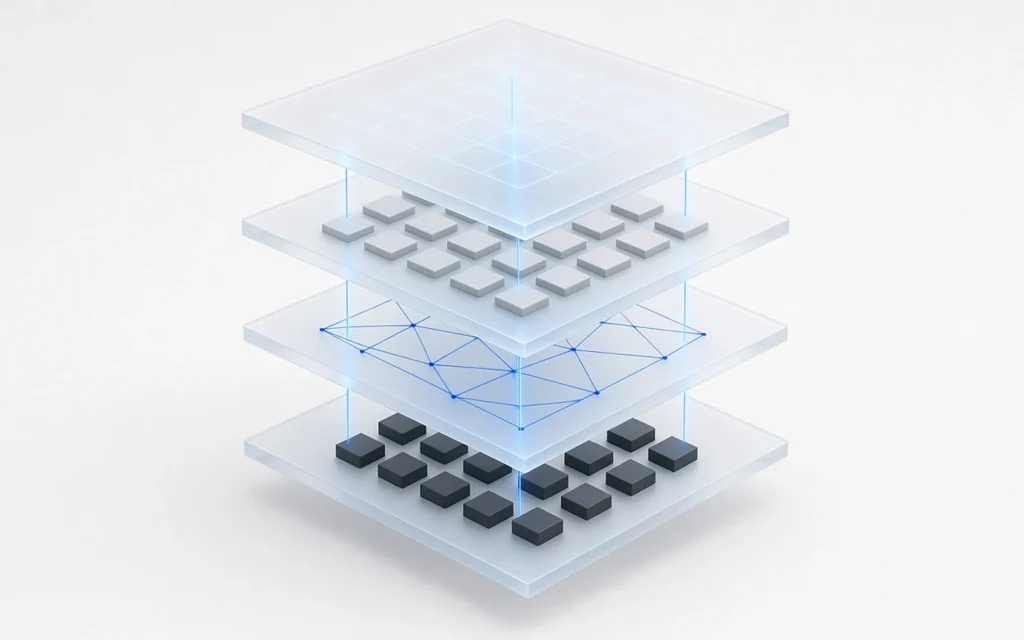
There are two layers to keep apart. Inside one server or rack, NVIDIA GPUs talk over NVLink, NVIDIA’s own high-speed link. Between servers, you need a cluster network, and that is where InfiniBand and Ethernet compete.
InfiniBand in short
InfiniBand is a network built specifically for high-performance computing. It is “lossless” by design: it does not drop data when traffic gets heavy, because each switch only sends what the next one can receive. NVIDIA’s current generation, Quantum-X800, offers switch ports at 800 Gb/s (gigabits per second). It also supports SHARP, a feature that lets the switch do part of the GPUs’ shared calculations itself, which helps in large training jobs (OpenMetal).
The trade-off: InfiniBand is a separate network type that your team must learn and run alongside the normal data center network.
Ethernet for AI in short
Ethernet is the network almost every data center already uses. Standard Ethernet was not designed for AI traffic, but new platforms close much of the gap. NVIDIA Spectrum-X, for example, pairs Ethernet switches with “SuperNICs” (smart network cards) that route each packet around congestion and control traffic bursts. Broadcom, Cisco and Arista offer competing high-speed Ethernet switches as well.
The market has moved fast. According to Dell’Oro Group, Ethernet accounted for more than two-thirds of AI-cluster switch sales in 2025, while InfiniBand also kept growing (New Market Pitch, citing Dell’Oro). Large cloud and AI operators such as Amazon, Microsoft, Meta and Google are deploying Ethernet for AI.
Side-by-side comparison
| Question | InfiniBand | Ethernet (AI-optimized) |
|---|---|---|
| Best fit | Dedicated, large training clusters | Shared clusters, inference, mixed workloads |
| Behavior under load | Lossless by design | Near-lossless with adaptive routing and congestion control |
| Team skills | Specialist knowledge needed | Uses familiar Ethernet operations |
| Vendor choice | Mainly NVIDIA | Several switch vendors |
One useful detail: the NVIDIA ConnectX-8 SuperNIC supports both InfiniBand and Ethernet, with up to 800 Gb/s of total bandwidth (OpenMetal, citing the ConnectX-8 datasheet). So the server side can stay the same; the real decision is the switches and how your team runs them.
What is coming next: 800G now, 1.6T soon
Today, 800G is the main speed in AI cluster networks. At the OCP (Open Compute Project) Summit in October 2026, vendors showed 102.4 Tbps (terabits per second) switches with 1.6T ports, and NVIDIA moved its Spectrum-X Ethernet Photonics switches, which build the optics into the switch package, into production (Dell’Oro Group). For buyers, this means: plan cabling, optics and rack power with the next speed step in mind, so today’s purchase does not block tomorrow’s upgrade.
Whatever you choose, test it before full rollout. Meta, for example, stressed at OCP 2026 that AI networks should be validated under realistic load, congestion and failure conditions (Test4Net).
Key takeaways
- The network between servers can limit your GPUs as much as the GPUs themselves.
- Choose InfiniBand for dedicated, training-heavy clusters where every bit of performance counts.
- Choose AI-optimized Ethernet for shared clusters, inference and teams that already run Ethernet.
- 800G is today’s standard; plan for 1.6T in optics, cabling and power.
- Match switches, network cards and servers as one design, and test before full rollout.
Q9 Technology supplies networking, GPU and server hardware for AI clusters. For a matched configuration, contact our team. For more background, read GPU Server Solutions for AI.