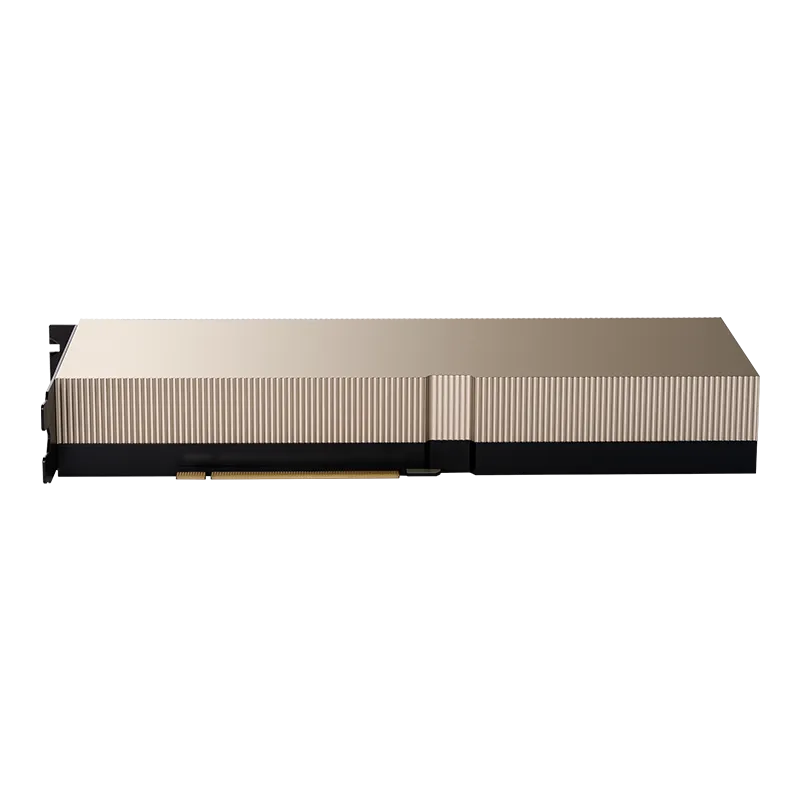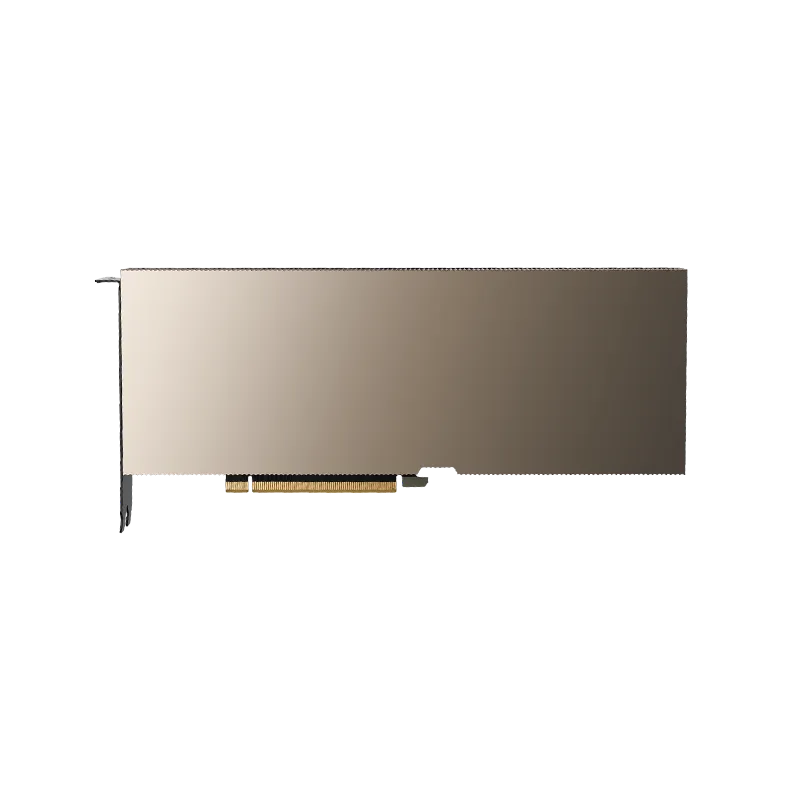
Supports AI training, inference, data analytics, and HPC workloads
MIG technology allows flexible partitioning for diverse workload needs
Third-gen Tensor Cores support advanced precisions: TF32, FP64, BFLOAT16, INT8, INT4
TF32 enables 20x AI performance with no code changes
Efficient handling of large datasets and models with 95% DRAM utilization
Structural sparsity doubles throughput for sparse AI models
Seamless integration with major AI frameworks and 700+ HPC applications
Enhanced multi-GPU scalability using next-gen NVLink
Optimized for both bare metal and virtualized environments including Kubernetes and VMware
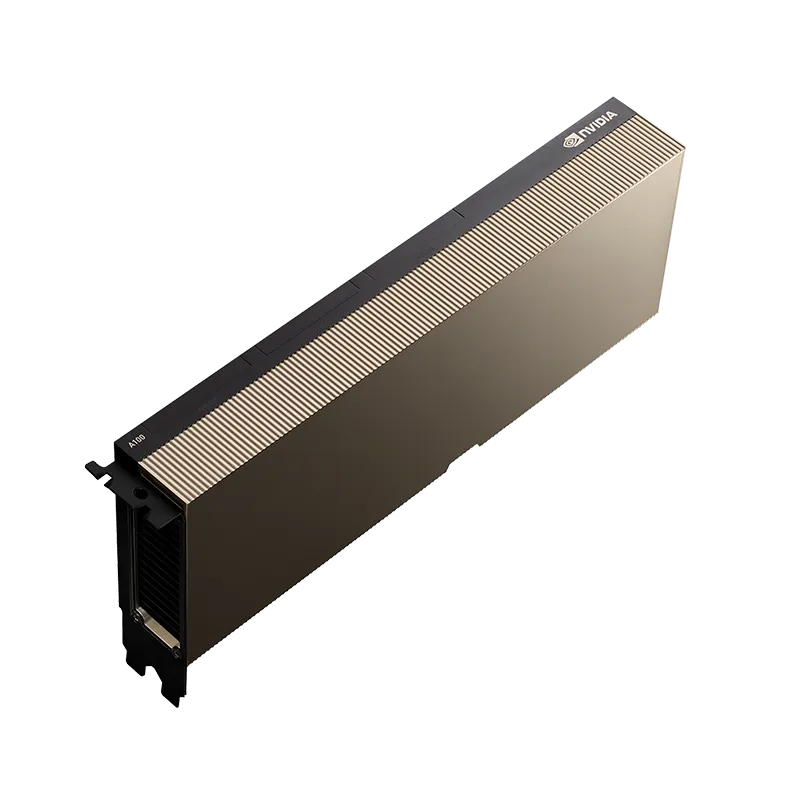
The NVIDIA A100 80GB Tensor Core GPU delivers groundbreaking acceleration across all scales, enabling the highest-performing elastic data centers globally. It supports AI, data analytics, and high-performance computing (HPC) applications with unmatched speed and efficiency. As the cornerstone of NVIDIA’s data center platform, the A100 offers performance gains up to 20 times greater than the previous NVIDIA Volta generation. Utilizing Multi-Instance GPU (MIG) technology, a single A100 can be segmented into seven fully isolated GPU instances, creating a flexible platform that adapts dynamically to changing workload demands.
This GPU forms part of NVIDIA’s comprehensive data center ecosystem, combining cutting-edge hardware, networking solutions, advanced software, libraries, and AI models optimized through NVIDIA GPU Cloud (NGC). This all-encompassing AI and HPC platform enables researchers to generate tangible results and deploy scalable production solutions while allowing IT teams to maximize the use of every A100 GPU available.
|
|
|
|
|
|
|
|
|
|
|
|
|
|
|
|
|
|
|
|
The A100 GPU is engineered to accelerate workloads ranging from small tasks to large-scale multi-node operations. It offers tremendous flexibility through Multi-Instance GPU (MIG) technology, which partitions the physical GPU into multiple isolated instances tailored for varying workload sizes. For massive workloads, multiple A100 GPUs can be interconnected via NVLink, delivering superior performance in parallel. This scalable architecture enables users to address the full spectrum of computational demands with ease.
Tensor Cores debuted in NVIDIA’s Volta architecture, revolutionizing AI training and inference by significantly accelerating computations, reducing AI training times from weeks to hours. The Ampere architecture’s third-generation Tensor Cores advance this innovation by delivering up to 20 times more floating-point operations per second (FLOPS) for AI tasks. They enhance performance across existing precision types and introduce new ones — including TF32, INT8, and FP64 — simplifying AI adoption and extending Tensor Core capabilities to HPC workloads.
AI workloads continue to expand rapidly in complexity and size, increasing computational demands dramatically. While lower-precision math formats traditionally provided speed benefits, they often required software modifications. The A100 introduces TF32, a new precision that operates like FP32 but delivers 20 times the AI performance without needing any code changes. Additionally, NVIDIA’s automatic mixed precision feature allows developers to double performance by enabling FP16 precision with minimal code updates. The A100’s Tensor Cores also support BFLOAT16, INT8, and INT4, making it a versatile solution for both AI training and inference scenarios.
The NVIDIA A100 extends Tensor Core acceleration to double-precision (FP64) operations, marking the most significant advancement for HPC since GPUs adopted FP64 computing. Its third-generation Tensor Cores support fully IEEE-compliant FP64 matrix operations, delivering up to 2.5 times more performance and efficiency for HPC applications requiring high-precision math. These improvements are enhanced by NVIDIA CUDA-X math libraries, benefitting scientific simulations, modeling, and other double-precision intensive workloads.
Not all AI or HPC workloads need the full power of an entire A100 GPU. With Multi-Instance GPU (MIG) technology, a single A100 can be divided into up to seven fully isolated GPU instances, each with its own dedicated memory, cache, and compute cores. This provides developers with breakthrough acceleration for tasks of any size while guaranteeing consistent quality of service. For IT administrators, MIG enables optimal resource allocation, expanding GPU access across more users and applications for improved overall utilization.
MIG is supported in both bare metal and virtualized environments, integrated seamlessly with NVIDIA Container Runtime and compatible with container runtimes such as Docker, LXC, CRI-O, Containerd, Podman, and Singularity. In Kubernetes environments, each MIG instance is recognized as a distinct GPU type, compatible with major Kubernetes distributions like Red Hat OpenShift and VMware Project Pacific, on-premises or in cloud deployments via NVIDIA Device Plugin for Kubernetes. Additionally, MIG supports hypervisor-based virtualization solutions including KVM and VMware ESXi through NVIDIA vComputeServer.
The A100 is equipped with an impressive 80GB of HBM2e high-bandwidth memory, which delivers raw bandwidth of 1.6 TB/s, representing a 1.7 times increase compared to the previous generation. With dynamic random access memory (DRAM) utilization efficiency of 95%, the A100 handles large models and datasets efficiently, reducing bottlenecks and speeding up complex computations.
AI models frequently contain millions or even billions of parameters, but not all contribute equally to accuracy. By converting some parameters to zero, models become “sparse” without losing predictive power. The A100’s Tensor Cores accelerate sparse matrix operations, offering up to double the throughput for sparse models. Although sparsity benefits are more pronounced during AI inference, it also contributes to faster training times.
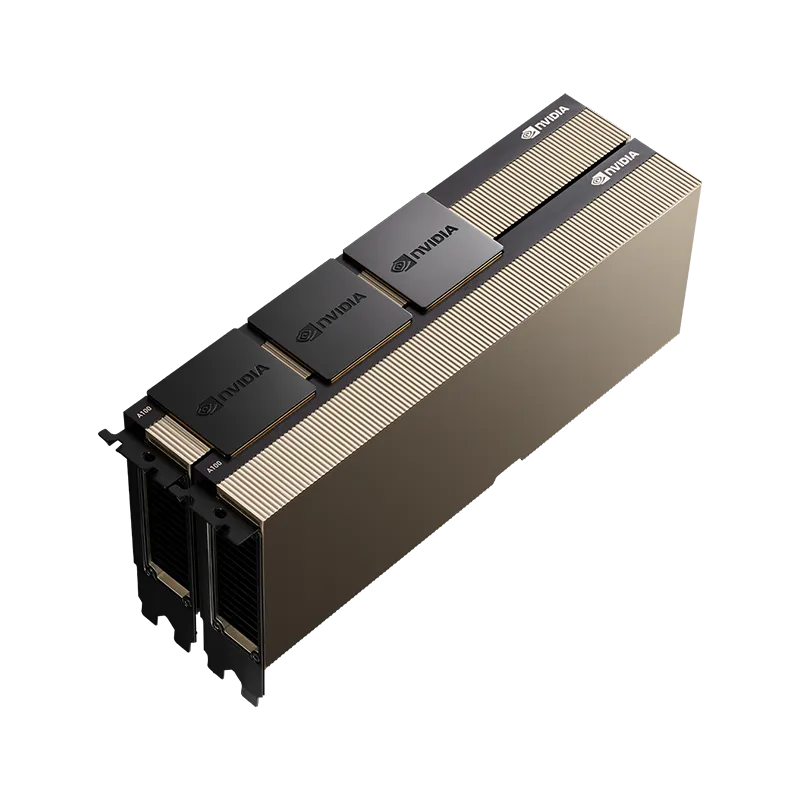
NVIDIA’s NVLink interconnect technology in the A100 provides double the throughput of the previous generation, reaching up to 600 GB/s. This high-speed link enables multiple A100 GPUs to communicate efficiently within a single server, dramatically improving application performance. Two PCIe A100 boards can be connected via NVLink, and multiple NVLink pairs can coexist in a server depending on system design, cooling, and power capabilities.
The NVIDIA A100 Tensor Core GPU supports every major deep learning framework and accelerates over 700 HPC applications. It is widely deployed in desktops, servers, and cloud environments, delivering substantial performance improvements and cost savings.
The A100 is well-suited for virtualized compute environments, supporting workloads such as AI, deep learning, and HPC through NVIDIA Virtual Compute Server (vCS). It provides an ideal upgrade path for infrastructures currently using V100 or V100S GPUs.
Modern AI networks often contain vast numbers of parameters, many of which can be sparsified (converted to zero) without impacting model accuracy. The A100 leverages this by delivering up to twice the performance for sparse models, with most benefits seen in inference, but also improving training speeds.
|
|
|
|
|
|
|
|
|
|
|
|
|
|
|
|
|
|
|
|
Unprecedented Performance at Scale
Powered by the NVIDIA Ampere architecture, the A100 delivers up to 20× higher performance than the previous generation for AI, data analytics, and HPC workloads – all from a single accelerator.
Massive 80 GB HBM2e with Over 2 TB/s Bandwidth
The A100 80 GB configuration features high-bandwidth memory (HBM2e) delivering over 2 terabytes per second of memory bandwidth — the fastest ever on a PCIe card — enabling massive model training and data processing.
Third‑Generation Tensor Cores with Sparsity Support
Boosted by 432 third-gen Tensor Cores, the GPU supports TF32, FP16/BF16, INT8, INT4, and new structural sparsity features—delivering up to 312 TFLOPS (624 TFLOPS with sparsity) for deep learning acceleration.
Multi‑Instance GPU (MIG) Virtualization
Enables up to 7 independent GPU instances per card (each with up to 10 GB), ideal for multi-tenant, elastic workloads that maximize resource utilization.
High-Speed NVLink and PCIe Gen 4 Interconnects
Supports PCIe Gen 4 x16 (64 GB/s) and three NVLink bridges delivering 600 GB/s total bi-directional bandwidth, accelerating multi-GPU scaling .
FP64 Tensor Cores for HPC
Offers 19.5 TFLOPS of IEEE‑compliant FP64 performance through Tensor Cores—significantly boosting high-precision HPC workloads.
Passive, Dual-Slot Data Center Design
Housed in a full-height, full-length PCIe form factor with passive cooling, it operates at a configurable 300 W TDP within standard server airflow .
Enterprise-Grade Security
Includes a hardware “root of trust” enabling secure boot, firmware validation, and rollback protection — essential for mission-critical environments .
Software Ecosystem Integration
Fully compatible with NVIDIA’s AI Enterprise, CUDA, cuDNN, TensorRT, Magnum IO, and support for MIG, making it turnkey for data center deployment .
Your email address will not be published. Required fields are marked *